

Is 7-OH Banned Yet? 2026 DEA Scheduling Status

Last updated: July 6, 2026. We update this page as the status changes.

The short answer...
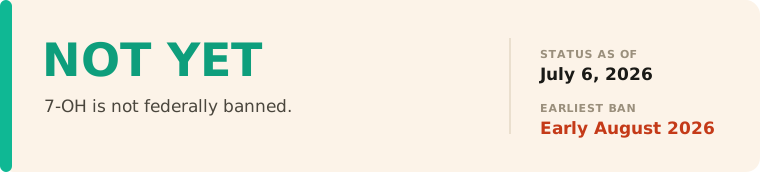
No — as of July 6, 2026, 7-OH is not yet federally banned. The DEA has started the process to make it illegal, but the ban has not taken effect.
Here’s where things actually stand:
- The DEA has filed formal notice of its intent to place concentrated 7-OH into Schedule I — the same category as heroin and LSD.
- That notice publishes in the Federal Register on July 6, 2026, which starts a legally required 30-day waiting period.
- The earliest the ban can take effect is early August 2026.
- It targets concentrated and synthetic 7-OH products — not natural whole-leaf kratom.
- Some states have already banned it under their own laws, regardless of federal status.
So if you’re asking “can I still buy it right now?” — federally, yes, for the moment. But the window is closing fast, and where you live may already say no.
What is 7-OH?
7-OH is short for 7-hydroxymitragynine, one of the active compounds found in kratom. In the natural kratom leaf it exists only in trace amounts. The products now under scrutiny aren’t the leaf — they’re concentrated and synthesized versions: tablets, gummies, shots, and drink mixes engineered to contain far higher levels of 7-OH than anything that occurs in nature.
That concentration is the whole issue. Regulators describe high-potency 7-OH as behaving like an opioid — it acts on the same receptor system as morphine and prescription painkillers. One poison-center director quoted in recent coverage estimated concentrated 7-OH can be several times more potent than morphine, and poison centers have reported a sharp rise in severe cases tied to these products.
What the DEA actually did
On July 1, 2026, the DEA issued two Notices of Intent to temporarily add 7-OH and related compounds to Schedule I of the Controlled Substances Act. DEA Administrator Terrance Cole framed the action as targeting highly concentrated, synthetic 7-OH products that pose a growing threat to public health.
Two notices were filed:
- 7-OH above a specified threshold — the concentrated compound itself.
- Three synthetic derivatives — mitragynine pseudoindoxyl (MP), MGM-15 (dihydro-7-hydroxymitragynine), and MGM-16 (a fluorinated derivative). These don’t occur in the kratom plant at all.
The Department of Health and Human Services and the FDA both publicly backed the move. HHS also opened a public-comment window (a Request for Information) on the proposed concentration threshold.
The Timeline
- July 28–29, 2025 — HHS/FDA formally recommend that the DEA classify concentrated 7-OH as Schedule I.
- July 1, 2026 — DEA files two Notices of Intent to begin temporary scheduling.
- July 6, 2026 — The notice publishes in the Federal Register, starting a mandatory 30-day waiting period.
- Early August 2026 (earliest) — The temporary scheduling order can take effect. At that point, manufacturing, distributing, or possessing covered products becomes subject to Schedule I criminal, civil, and administrative penalties.
- Two years — The temporary order lasts two years, extendable by one more, while the DEA works toward permanent scheduling.

What's actually covered — and what isn't
This is the detail most headlines get wrong. The scheduling is built around a concentration threshold, not a blanket kratom ban. Based on the reporting, the action targets:
- Botanical kratom products containing more than 0.05% 7-OH by dry weight, or
- Synthetic or processed products (extracts, tablets, gummies, shots) containing more than 0.05% 7-OH by weight, or more than 1 mg of 7-OH per product.
Natural whole-leaf kratom contains only trace amounts of 7-OH — far below that line. HHS stated the action is not intended to regulate natural kratom leaf that doesn’t contain elevated 7-OH. That threshold was reportedly designed to capture the spiked and synthesized products while leaving the traditional plant alone.
So: concentrated and synthetic 7-OH is what’s being scheduled. Whole-leaf kratom, as such, is not the target of this federal action.

Federal vs. state: two different pictures
Even though there’s no federal ban in effect yet, 7-OH and kratom are already restricted or banned in a number of states, counties, and cities under their own laws. Several states regulate them through Kratom Consumer Protection Act (KCPA) statutes, and some have outright bans. Tennessee’s ban is in effect as of July 1, 2026.
The practical takeaway: your state law may already prohibit these products regardless of what the DEA does next. Federal status is only half the picture — always check your state and local rules.
What happens next
The 30-day waiting period runs through early August. During that time, HHS is collecting public comment on the proposed threshold. After the waiting period, the DEA can issue the temporary order, at which point the covered products become federally illegal to make, sell, or possess. The temporary schedule buys the agency up to two (potentially three) years to pursue a permanent classification.
For consumers and retailers, the on-the-ground reality is already shifting ahead of the legal deadline: many retailers are pulling concentrated 7-OH products from shelves rather than risk being caught holding Schedule I inventory in August.
Frequently asked questions
Is 7-OH illegal right now?
Not federally, as of July 6, 2026. The DEA has begun the scheduling process but the ban hasn’t taken effect. Some states already ban it.
When does the federal ban take effect?
The earliest is early August 2026, after a mandatory 30-day period following the July 6 Federal Register publication.
Does this ban all kratom?
No. The action targets concentrated and synthetic 7-OH above a specified threshold. Natural whole-leaf kratom, which contains only trace 7-OH, is not the target of this federal action — though state laws vary.
What's the difference between kratom and 7-OH?
Kratom is the natural leaf. 7-OH is one compound within it, present naturally in tiny amounts. The concern is products that concentrate or synthesize 7-OH to opioid-like potency.
How long will the ban last?
The temporary scheduling order lasts two years, with a possible one-year extension, while the DEA pursues permanent Schedule I classification.
On a separate note: a lot of people re-evaluating their daily routine around this news have been asking about cleaner ways to support steady energy and focus. If that’s you, we wrote a piece on the science of cellular energy here — it’s a different topic, but a useful one.
Sources
- DEA — Temporary Scheduling of 7-OH and Related Substances (press release)
- Federal Register — Temporary Placement of 7-Hydroxymitragynine in Schedule I
- HHS/FDA — Commend DEA Action on Enhanced 7-OH Products
- The Hill — DEA moves to ban opioid-like kratom compound 7-OH
- Pain News Network — DEA Will Classify 7-OH as Illegal Drug
- NutraIngredients — DEA moves to ban 7-OH, an ’emerging threat’
- Restoration Recovery — Is 7-OH Banned? 2026 Status Tracker
- Restoration Recovery — Kratom Laws by State 2026
- Venable LLP — FDA Announces Plan to Restrict 7-OH Opioid Products